Inhabiting
A human place for everyday life, belonging, creativity and culture.
HUI · Abundance Program · ICEBERG
Holopolis Network
A place to live, learn, create and care — conceived as part of a living relationship between the ocean and the world on land.
01Vision
Ocean Star imagines a regenerative settlement whose usefulness reaches far beyond its own shores.
Homes and shared places, food and forests, research and rescue, making and learning: the proposal brings these functions into one connected living system. Its measure of success is the well-being it helps create — for the people who live there, the communities it connects with and the ocean that supports it.
Within HUI, Ocean Star is a node in a wider process. The Abundance Program gives that process a lived expression through voluntary participation, shared capability and continual learning.
A human place for everyday life, belonging, creativity and culture.
Marine care and ecological observation belong within the design from the beginning.
Knowledge, materials, services and opportunities circulate between ocean and land.
02Explore in 3D
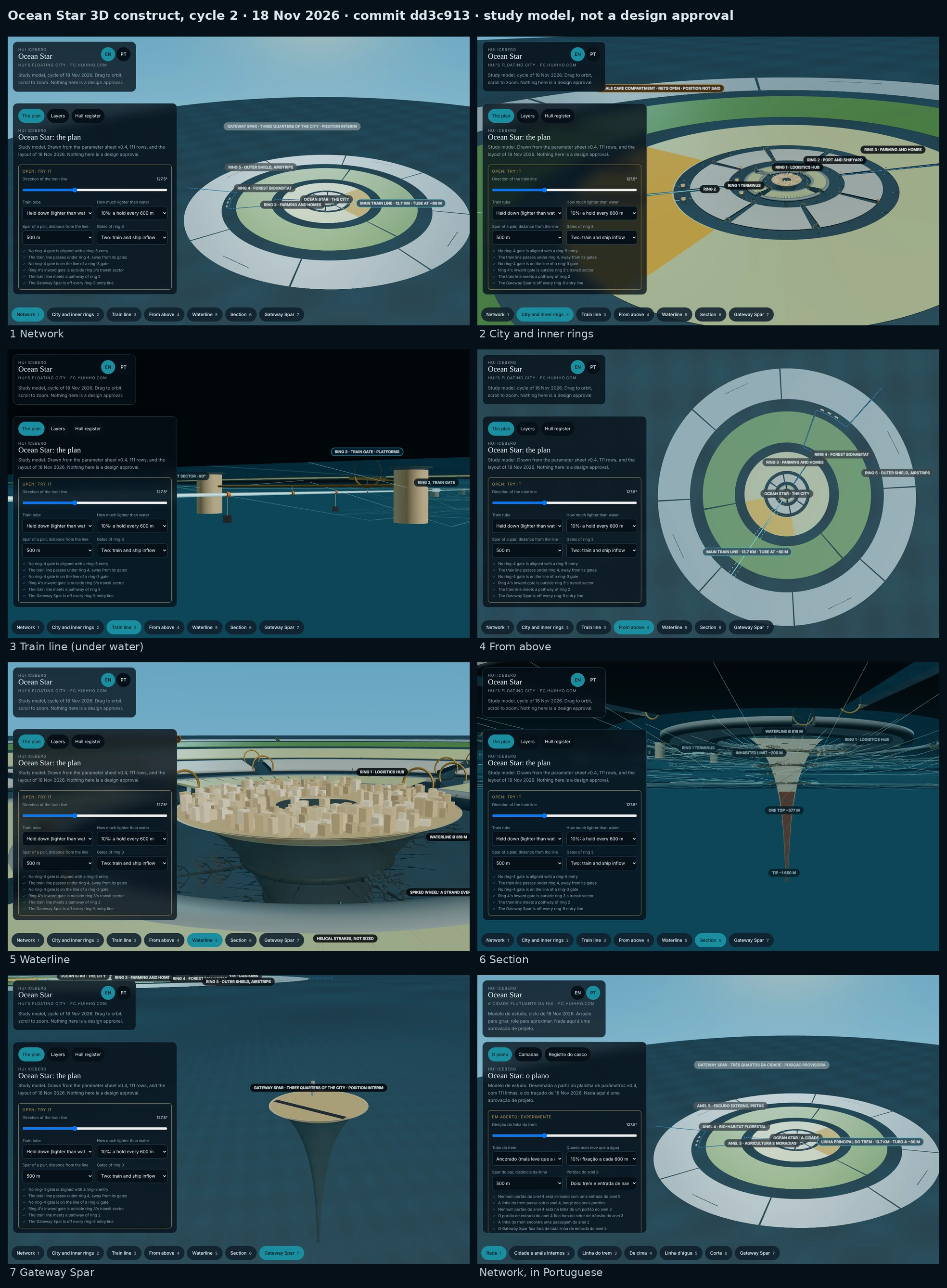
Move around the existing three-dimensional study. Change viewpoints, switch layers, inspect the hull and explore the relationships between the city, the rings, the train and the Gateway Spar.
The construct preserves the 18 November 2026 study. The public narrative includes later direction from 21 November. These dates matter: the model is a record of one development stage, with open assumptions you can inspect.
View the original study images03Five rings
Each ring serves a different role. Together they connect the central city with the wider ocean. Select a ring to explore its purpose.
Schematic of relationships. Spacing is illustrative.
Ring 01
The first ring supports the city and the wider network: movement, services, storage and the practical work of keeping a settlement alive.
The 21 November direction specifies a 540 m underwater body width. How the supporting spars and body work together remains an engineering study.
Ring 02
The working concept places the settlement’s port and shipbuilding activity in the second ring, with its detailed role continuing to evolve.
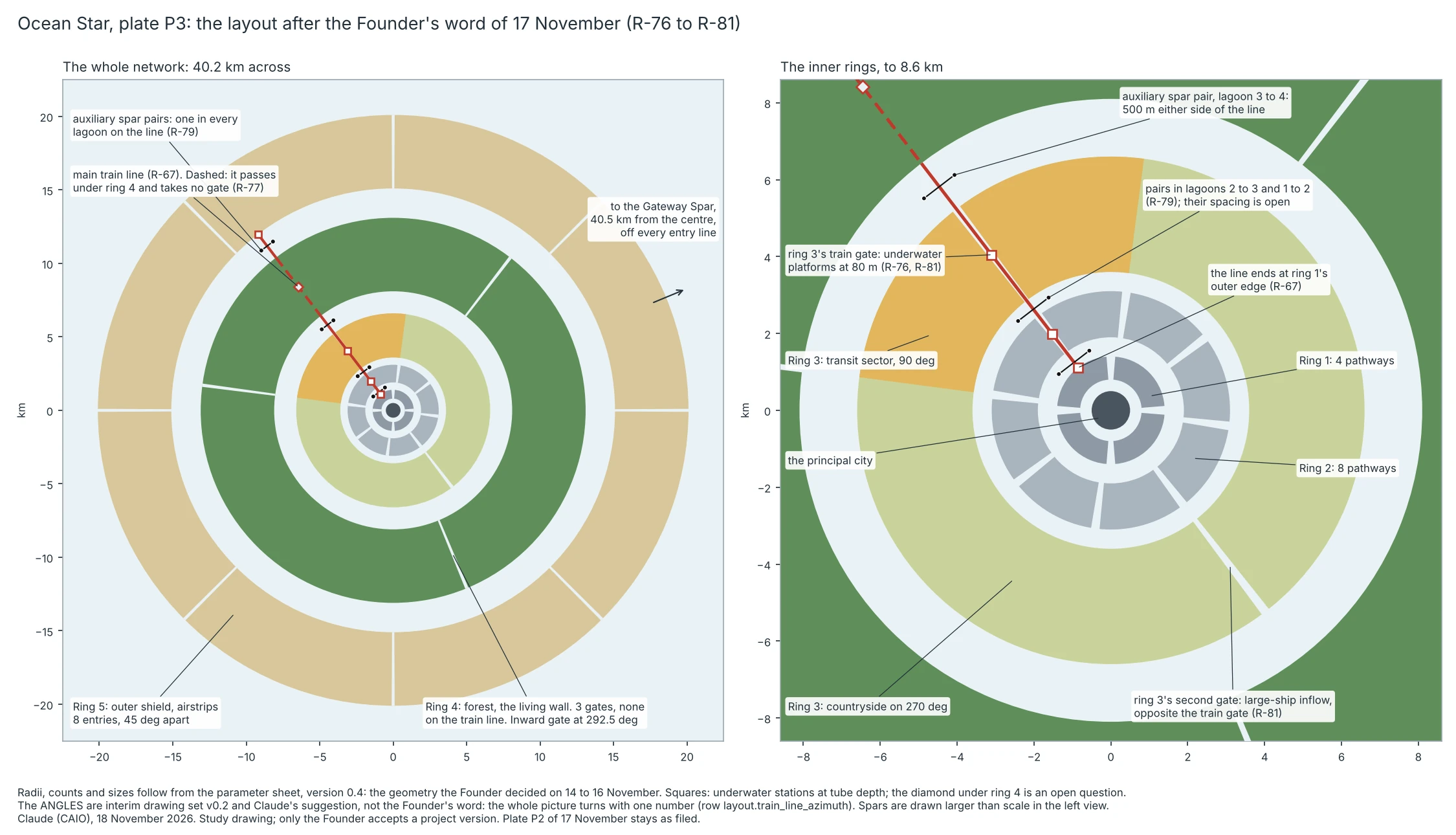
Current direction: eight pathways every 45°, halfway between spars. The supporting spar arrangement remains under study.
Ring 03
Agriculture, rural life and homes share the third ring. A distinct transit sector carries necessary movement while quieter areas support daily life.
The design seeks to reduce disturbance from passing ships; operating limits and wake criteria remain to be established.
Ring 04
The fourth ring is conceived as a forest and biohabitat — a living boundary that brings ecological functions into the settlement’s architecture.
Habitat design, species choices, stewardship and the relationship with transport require dedicated ecological and engineering work.
Ring 05
The outer ring combines protection, an ocean boulevard and proposed energy and air-access functions. It meets the open sea on behalf of the whole network.
The mix of energy systems, the extent of working deck and the performance of the outer protection remain research questions.
04The central city
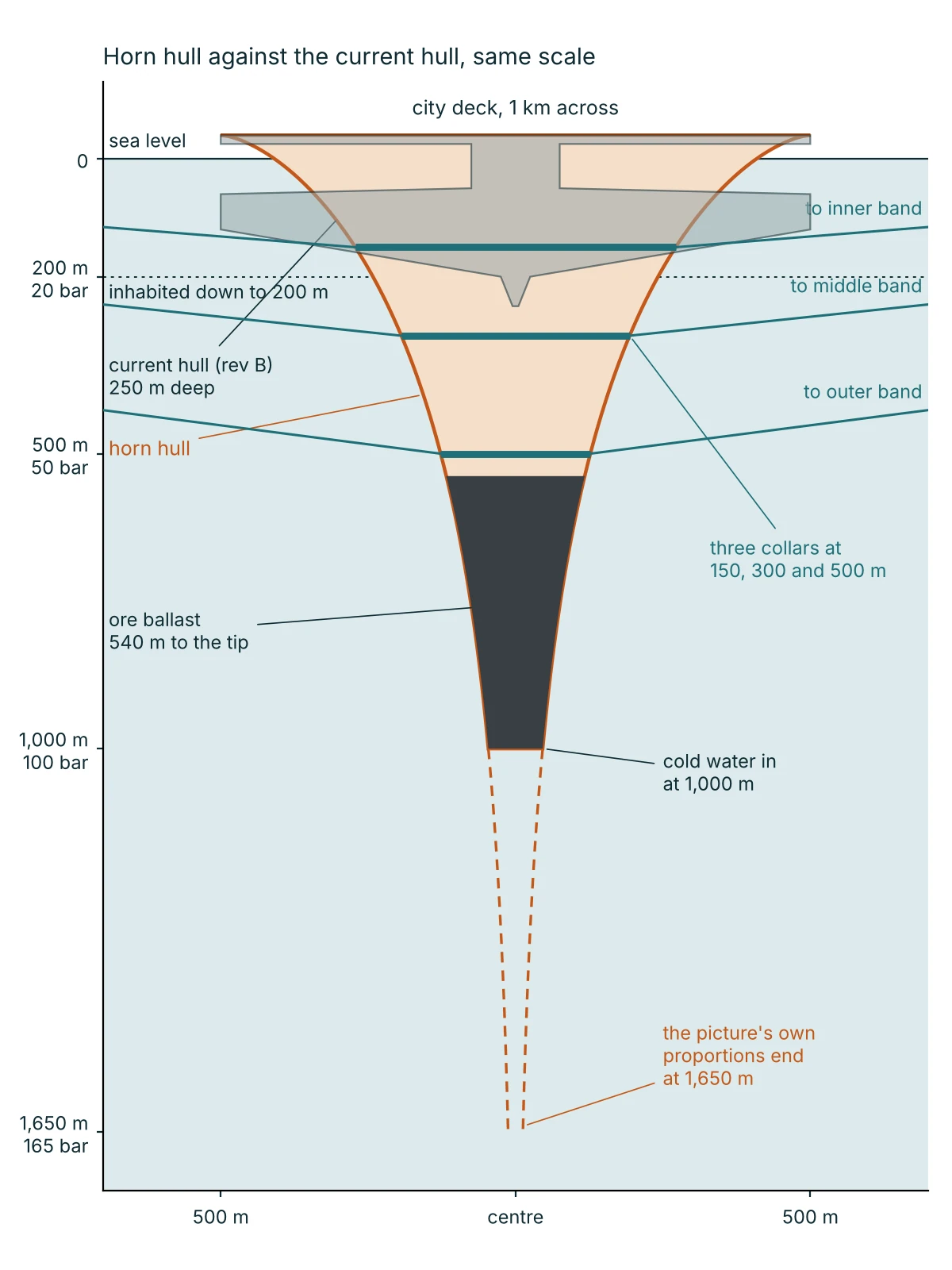
The central city is conceived for human life: homes, shared spaces, learning, culture and encounter. Heavy port operations and industrial activity sit elsewhere in the wider system. The horn-shaped hull is part of the study of how such a city could float, distribute loads and connect to the structure beneath the water.
The drawing compares historical hull studies. Its dimensions and internal arrangements are study inputs, not a completed engineering design.
05Engineering & interdependence
Ocean Star is being explored as a network of permanent borders, movable units and distributed support. The structure must be understood as a coupled system: flotation, loads, movement, materials, maintenance and the living ocean affect one another.
The hull studies examine geometry, internal cells, displacement and the distribution of mass. Reserve buoyancy is an intention to test against complete load cases.
Underwater strands and supporting spars are proposed to link the rings and hold relationships between them, including when movable units are away.
Parts of the settlement can change use or position while the connective infrastructure remains. Interfaces, tolerances and maintenance are part of the research.
The existing model exposes assumptions and inconsistencies. Hydrodynamics, structural fatigue, failure cases, full mass accounting and practical construction still require specialist validation.
06Mobility
An underwater main train line is proposed between the outer ring and the first ring, with stations at tube depth. Maritime pathways and gates connect port and service areas. Their arrangement aims to keep through-traffic away from the quieter residential, agricultural and forest spaces.
07Living ocean
Care is a function of the settlement, and a responsibility of its design.
The programme includes marine observation, habitat restoration studies, temporary rescue and rehabilitation, and support for people working at sea. Ecological baselines, independent monitoring and specialist care would guide how these functions are developed.
Study water, sound, movement and ecosystems across seasons. Compare conditions over time so effects can be understood.
Explore habitats and cultivation only where their ecological effects and compatibility with the wider ocean can be demonstrated.
Develop rescue and temporary animal-care concepts with EESSA and appropriate marine specialists, with welfare and release needs guiding the work.
The current direction is to study areas of roaming and transition, choosing what best serves Ocean Star’s usefulness in each season. Wind, waves, currents, marine habitats, navigation and coastal-state consent all belong in that decision. No operating route has been settled.
08Resource systems
Energy, water, food and materials are considered together. A useful output in one activity can become an input to another. The ambition is practical resilience: local capability, repair, reuse and relationships with communities and production on land.
Study a diverse energy mix, storage and demand together; solar area and marine operating conditions are design variables.
Connect treatment, use and recirculation while protecting marine water quality and maintaining dependable supply.
Join agriculture, cultivation, nutrition and ecological care, with evidence guiding what belongs in the marine setting.
Turn repair, ship services, sorting and recovery into a potential source of useful feedstock for future construction.
09Gateway Spar · Stratoforge
The Gateway Spar and Stratoforge studies extend the programme towards aerospace research and a future interface between ocean infrastructure and space activity. Their place within Ocean Star is exploratory: energy, materials, operations and safety must be developed together before performance can be established.
The existing construct shows a Gateway Spar study. Launch systems, capacities and operational readiness are not established by that model.
Actual interactive construct · cycle 2 · 18 November 2026
10Toroidal circulation
Ocean Star is conceived to give and receive. Land-based initiatives contribute materials, food, knowledge, services and capability; the ocean network can contribute research, making, restoration, rescue and new opportunities for learning and exchange. Value can move from large initiatives towards small ones, and from individual action towards wider collective capability.
Materials · knowledge · food · people · skills
Research · services · learning · making · opportunity
The aim is a reciprocal relationship that helps both places develop. The World Trade Village belongs to this connected evolution, emerging from real exchanges and practical usefulness.
11International convergence
The proposed Charter of the Ocean Star System is a framework to be developed through an international, cross-sector process. It explores shared responsibilities, consent, environmental care, participation and the conditions under which the system could operate.
The process has no assigned convener. Its institutions and mandate must emerge through the participation of the relevant parties.
Founding participation may bring early and priority access; the direction is never exclusivity.
Parties would seek and regularly review mutual benefit. Outcomes are an ongoing responsibility, not a guarantee.
12Research & development
Explore the ideas with their development stage in view. Publication makes the work accessible; it does not turn every study assumption into an accepted design.
Seven viewpoints and seventeen layers represent the city, rings, train, spars, Gateway Spar and selected systems. Some functions remain represented in text only.
Seasonal roaming and transition areas; Ring 1 underwater body width of 540 m; eight Ring 2 pathways between spars; the Charter of the Ocean Star System.
The existing construct and authentic visual studies are brought together with this bilingual entrance to the broader programme.
Original development visuals, retained as dated studies. Open an image to examine its labels and assumptions.
Discover the wider HUI ecosystem and the work that gives Ocean Star its context.